Tutorial on Parallelized Calculations
This tutorial demonstrates how to use QuantumDNA to calculate a range of observables that characterize the electronic and dynamic properties of DNA systems. By leveraging efficient computation and parallelization capabilities, you can analyze large datasets and complex systems.
Observables Covered:
Exciton Lifetime (femtoseconds) Estimate the lifetime of excitons, which play a critical role in energy transport and recombination processes within DNA.
Average Charge Separation (Å) Compute the spatial separation between electrons and holes, providing insights into charge transfer efficiency and molecular stability.
Dipole Moment (Debye) Analyze the molecular dipole moment, an important property that governs interactions with external fields and other molecules.
Average Exciton Population on Upper and Lower DNA Strands Quantify the distribution of exciton populations between the two DNA strands, shedding light on strand-specific dynamics and energy transport.
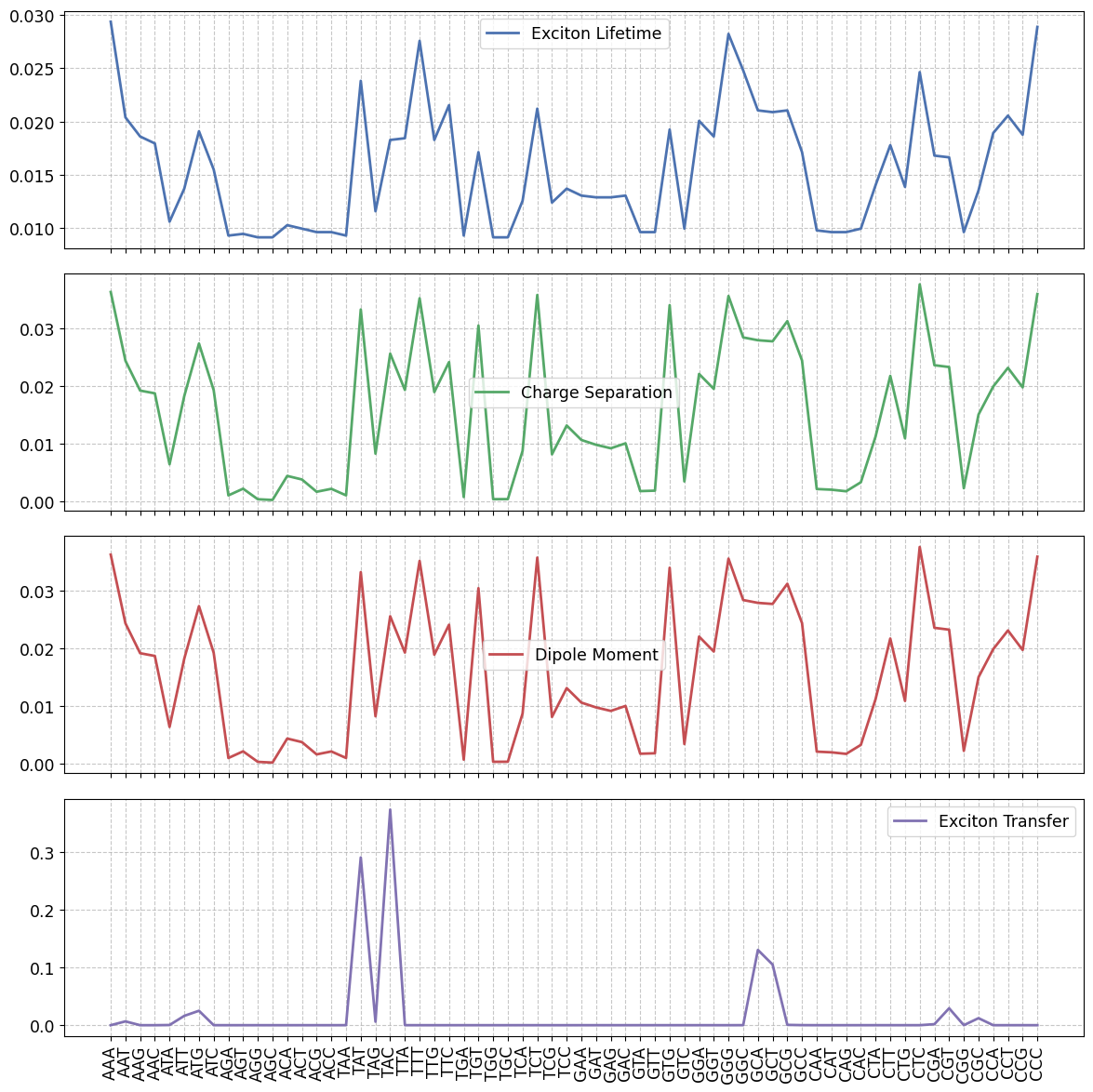
Example Application: As an illustrative example, the calculations are applied to all 64 possible DNA trimer/triplet sequences, allowing for a systematic investigation of how sequence composition influences these properties. This analysis showcases the versatility of the package for exploring sequence-dependent electronic characteristics.
By the end of this notebook, you will have an understanding of how to perform these calculations and utilize QuantumDNA’s parallelization features to efficiently analyze large-scale systems.

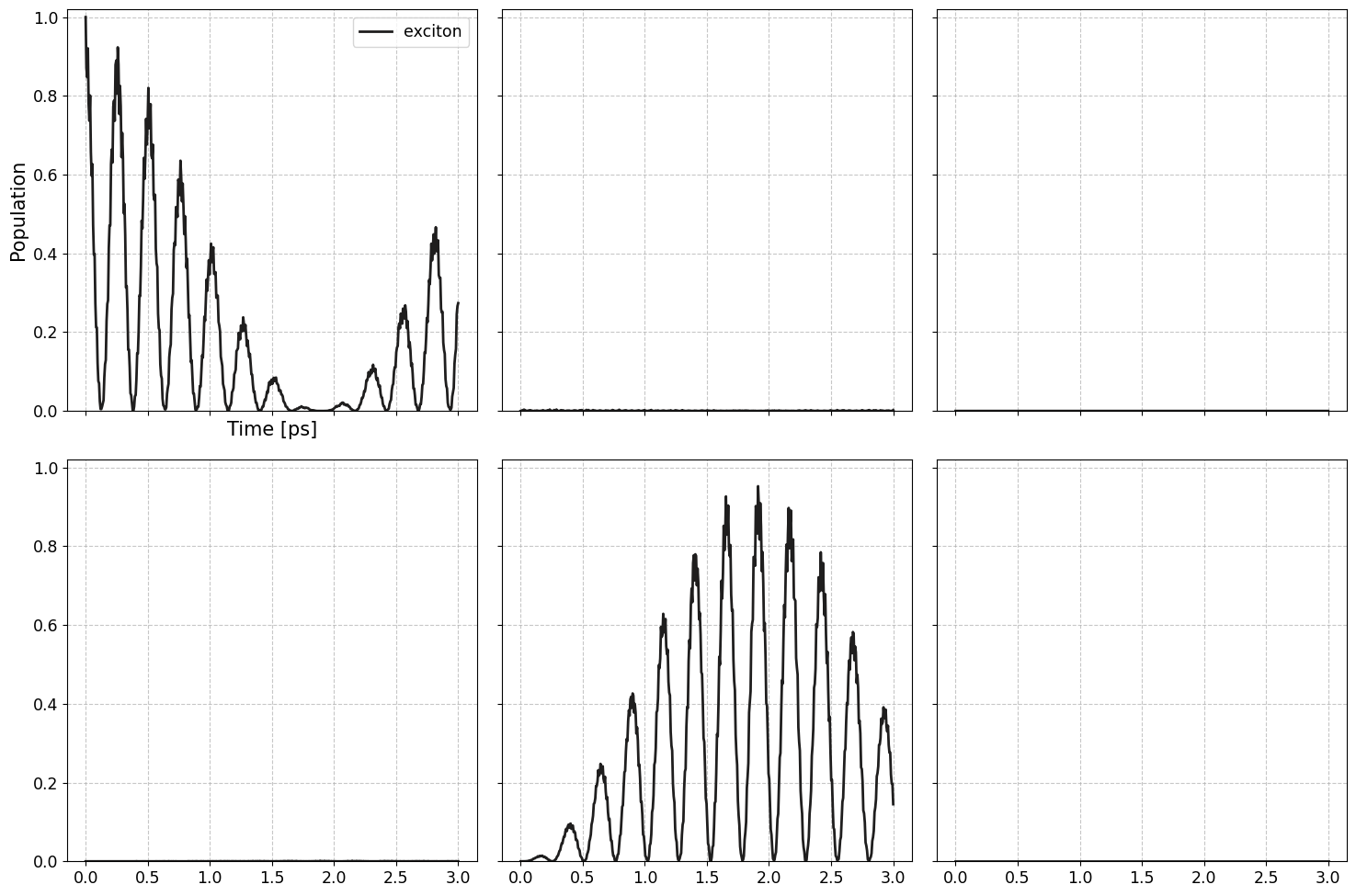
[2]:
%load_ext autoreload
%autoreload 2

# Save flag: Set to True to enable saving results (currently unused in this script)
save = False

# Verbose flag: Set to True to enable detailed logging
verbose = False
Setup
[3]:
import numpy as np
import matplotlib.pyplot as plt

# --------------------------
# Installation of QuantumDNA
# --------------------------

from importlib.util import find_spec

qDNA_installed = find_spec('qDNA') is not None

if not qDNA_installed:
    %pip install qDNA
    print("Successfully installed the 'qDNA' package.")
else:
    print("Package 'qDNA' is already installed.")

if verbose:
    %pip show qDNA

# ------------------------
# Directory Setup
# ------------------------

import os

# Use the current working directory as the root
ROOT_DIR = os.getcwd()

# Define directories to load data
DATA_DIR = os.path.join(ROOT_DIR, "data", "my_evaluation")
os.makedirs(DATA_DIR, exist_ok=True)

# Define directory to save figures
SAVE_DIR = os.path.join(ROOT_DIR, "my_figures")
os.makedirs(SAVE_DIR, exist_ok=True)

if verbose:
    print(f"Data directory: '{DATA_DIR}' is ready.")
    print(f"Save directory: '{SAVE_DIR}' is ready.")
Package 'qDNA' is already installed.
Parallelized Calculations for DNA Trimers
[5]:
import time
from qDNA import create_upper_strands

upper_strands = create_upper_strands(3, ['A','T','G','C'])
tb_model_name = 'ELM'
filename = 'parallel'
kwargs = dict(relax_rate=3, unit='rad/ps')
[ ]:
from qDNA import calc_lifetime, calc_lifetime_dict

start = time.time()
calc_lifetime_dict(upper_strands, tb_model_name, filename, DATA_DIR, **kwargs)
end = time.time()

print(f"Time with Parallelization: {round(end - start, 2)}s")

start = time.time()
lifetime_dict = {}
for upper_strand in upper_strands:
    lifetime_dict[upper_strand] = calc_lifetime(upper_strand, tb_model_name, **kwargs )
end = time.time()

print(f"Time without Parallelization: {round(end - start, 2)}s")
Time with Parallelization: 17.82s
Time without Parallelization: 106.88s
[ ]:
from qDNA import calc_dipole_dict, calc_dipole_moment_dict, calc_exciton_transfer_dict

start = time.time()
calc_dipole_dict(tb_model_name, filename, DATA_DIR)
calc_dipole_moment_dict(tb_model_name, filename, DATA_DIR)
calc_exciton_transfer_dict(tb_model_name, filename, DATA_DIR)
end = time.time()

print(f"Time: {end - start}s")
Time: 15.119956731796265s
DNA Trimer Analysis
[6]:
# load the dictionaries
from qDNA import load_json

lifetime_dict = load_json(f"lifetime_{filename}", DATA_DIR)
dipole_dict = load_json(f"dipole_{filename}", DATA_DIR)
dipole_moment_dict = load_json(f"dipole_moment_{filename}", DATA_DIR)
exciton_transfer_dict = load_json(f"exciton_transfer_{filename}", DATA_DIR)

# consider only the lower strand average exciton population
exciton_transfer_lower_dict = {key: value[1]['exciton'] for key, value in exciton_transfer_dict.items()}
[7]:
import seaborn as sns

def normalize_dict_values(data):
    total = sum(data.values())
    return {key: value / total for key, value in data.items()}

dicts = [normalize_dict_values(dictionary) for dictionary in [lifetime_dict, dipole_dict, dipole_moment_dict, exciton_transfer_lower_dict]]
labels = ['Exciton Lifetime', 'Charge Separation', 'Dipole Moment', 'Exciton Transfer']
colors = sns.color_palette()[:4]

fig, ax = plt.subplots(4, 1, figsize=(12,12), sharex=True)
for i in range(4):
    dictionary = dicts[i]
    ax[i].plot(range(64), dictionary.values(), label=labels[i], color=colors[i])
    ax[i].legend()

dna_seqs = list(lifetime_dict.keys())
ax[-1].set_xticks(range(64), labels=dna_seqs, rotation=90)

if save:
    fig_filename = input("Filename for Saving: ")
    plt.savefig(os.path.join(SAVE_DIR, fig_filename + '.pdf'))
[8]:
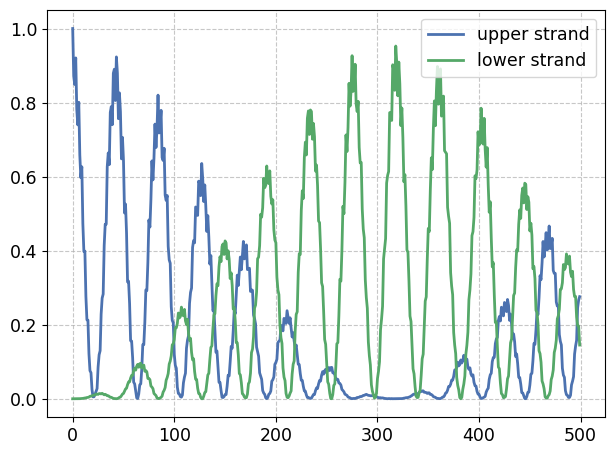
# The analysis above shows there are some intersting triplet sequences (TAT, TAC, GCA, GCT). Let's have a closer look.
from qDNA import calc_exciton_transfer

upper_strand ='GCT'
tb_model_name = 'ELM'
kwargs = dict(particles=['exciton'])

pop_upper_strand, pop_lower_strand = calc_exciton_transfer(upper_strand, tb_model_name, average=False, **kwargs)

fig, ax = plt.subplots()
ax.plot(pop_upper_strand['exciton'], label='upper strand')
ax.plot(pop_lower_strand['exciton'], label='lower strand')
ax.legend()

if save:
    fig_filename = input("Filename for Saving: ")
    plt.savefig(os.path.join(SAVE_DIR, fig_filename + '.pdf'))
[9]:
# we observe how the exciton gets transferred to the lower strand

from qDNA import get_me_solver, plot_pops

me_solver = get_me_solver(upper_strand, tb_model_name, **kwargs)

fig, ax = plot_pops(me_solver)

if save:
    fig_filename = input("Filename for Saving: ")
    plt.savefig(os.path.join(SAVE_DIR, fig_filename + '.pdf'))